
The Central Teacher Eligibility Test (CTET) is a key step for anyone looking to start a teaching career, and having a solid study plan is really important for doing well. According to the official notice, the CTET exam is given in an offline, pen-and-paper format. Candidates should focus on reviewing essential subjects, including child development and teaching methods, as well as specific areas like Mathematics, Science, and Social Studies. Regularly practicing with sample papers and taking mock exams helps understand the exam format and spot any weak areas. Staying updated with official CTET notifications, sticking to a steady study schedule, and frequently revising can really boost your performance in the CTET exam.
How to Start Preparation for the Central Teacher Eligibility Test Exam?
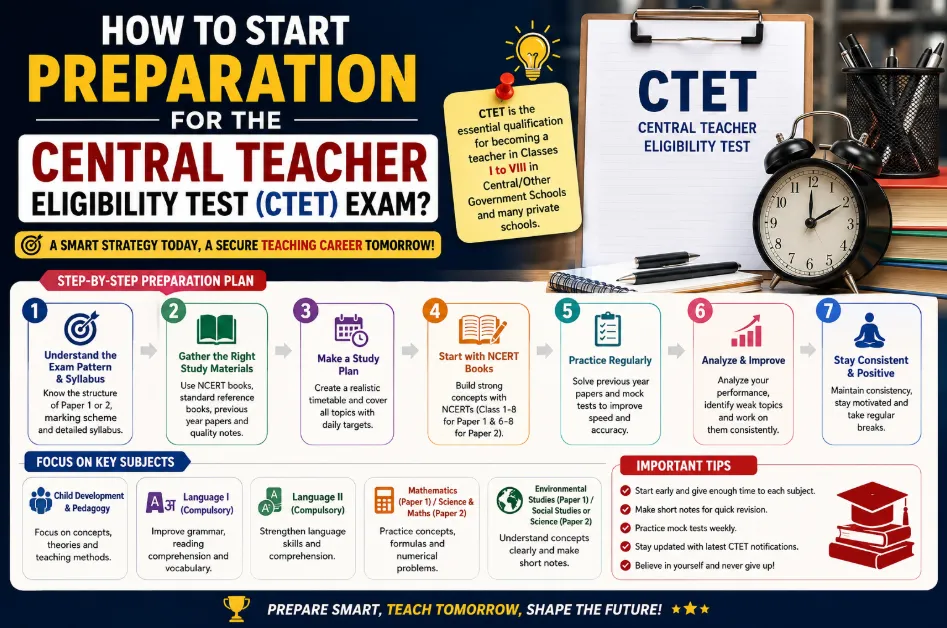
The CTET exam, run by CBSE all over the country, is an essential exam for aspiring teachers, alongside state-specific Teaching Eligibility Tests. As the competition ramps up and more people take the exam every year, it definitely comes with some tough challenges. By understanding the competitive nature of the exam and following a dedicated study plan, candidates can improve their chances of success and start a rewarding career in teaching.
Preparation Tips for Central Teacher Eligibility Test Exam?
Success in the CTET demands a well-organized and strategic approach. Begin by getting a clear understanding of the exam pattern and syllabus, and concentrate on building up your knowledge in key areas like child development, pedagogy, and subject-specific topics. Regularly practicing with past exam papers and mock tests can really help boost your accuracy and speed. Managing your time is vital, so make sure to practice solving questions within specific timeframes. Keeping up with the latest educational trends and sticking to a consistent study routine will help you prepare thoroughly and effectively for the exam.
Study Routine Plan for Central Teacher Eligibility Test Exam?
A good study routine is key for preparing effectively for the CTET. It helps candidates allocate enough time to each subject and thoroughly cover the whole syllabus. Sticking to a steady routine boosts understanding and retention of concepts, while regular practice sharpens problem-solving skills. Finding a balance between theory, revision, and mock tests allows candidates to track their progress and manage their time better. Staying disciplined cuts down on last-minute stress, boosts confidence, and really boosts the chances of doing well on the CTET exam.
यह भी पढ़ें: Railway Exam Preparation Guide (RRB Group D)
| Subject | Daily Time | What to Focus On |
|---|---|---|
| Child Pedagogy | 1–2 hours | Understand key theories like Piaget’s stages, moral development, and how children learn in different environments. Focus on concepts rather than memorization. |
| Mathematics | 2 hours | Practice number system, basic arithmetic, and important formulas. Also, spend time on Maths pedagogy to understand how concepts are taught effectively. |
| Science | 1.5–2 hours | Cover important topics such as human body systems, basic physics and chemistry concepts, along with science pedagogy for teaching methods. |
| Social Studies | 1.5–2 hours | Study constitutional articles, historical dynasties, geography, and agriculture. Focus on understanding facts and linking them with real-life examples. |
| English | 1.5 hours | Work on reading comprehension, poems, grammar basics, and teaching methods related to language learning. |
| Hindi | 1.5 hours | Practice comprehension passages, poems, grammar, and pedagogy concepts to strengthen teaching skills in Hindi. |
How to Crack CTET Exam
To pass the CTET on your first try, it’s important to have a clear and strategic game plan. Start by really getting to know the exam pattern and syllabus, and pinpoint where you might struggle. Focus on Child Development and Pedagogy since those topics are really important. Create a balanced study schedule that includes daily reviews, building your concepts, and working through past question papers. Taking regular mock tests will help boost your accuracy and manage your time better. Keep yourself updated on current educational policies and teaching methods, and remember to stay consistent, disciplined, and confident to improve your chances of success in the exam.
Exam Pattern and Syllabus for Central Teacher Eligibility Test
CTET is conducted at two levels—Paper 1 and Paper 2. Although both papers follow the same exam pattern, their syllabus is different based on the teaching level. Understanding this difference is important for effective preparation.
CTET Paper 1 (Primary Level: Class 1 to 5)
| Section | Details |
|---|---|
| Child Development & Pedagogy | Focus on child psychology, learning theories, and teaching approaches for young learners |
| Language I (Compulsory) | Tests proficiency in the chosen language, including comprehension and basic pedagogy |
| Language II (Compulsory) | Evaluates understanding of another language with emphasis on teaching methods |
| Mathematics + Pedagogy | Covers basic maths concepts along with ways to teach them effectively |
| Environmental Studies + Pedagogy | Includes topics related to environment, daily life concepts, and teaching strategies |
CTET Paper 2 (Upper Primary Level: Class 6 to 8)
| Section | Details |
|---|---|
| Child Development & Pedagogy | Focus on child psychology, learning theories, and teaching approaches for young learners |
| Language I (Compulsory) | Tests proficiency in the chosen language, including comprehension and basic pedagogy |
| Language II (Compulsory) | Evaluates understanding of another language with emphasis on teaching methods |
| Mathematics + Pedagogy | Covers basic maths concepts along with ways to teach them effectively |
| Environmental Studies + Pedagogy | Includes topics related to environment, daily life concepts, and teaching strategies |
Important Points for CTET exam
- The CTET tests are administered in an in-person format.
- Candidates must tackle 150 questions within a timeframe of 150 minutes, averaging one minute per item. Therefore, swiftness is clearly crucial here.
- There is no penalty for incorrect answers.
- Pedagogy: This area accounts for as much as 30 marks and features in half of the questions across other sections, making thorough preparation for it highly essential.
Detailed How to clear the CTET exam
To pass the CTET exam, candidates should take a strategic approach and thoroughly understand the exam structure, curriculum, and marking scheme. Regular practice with CTET sample papers and mock examinations is essential for enhancing performance. Furthermore, focusing on weaker areas, revisiting key concepts, and remaining up to date on current events are critical techniques for improving preparation and achieving success.
Basic Concepts and How to Solve CTET Mock Tests
Identify and clearly comprehend all of the fundamental principles in each course. Questions are typically asked from the basics, and while the CTET is a speed test, understanding the fundamental principles is quite beneficial. Have a thorough understanding of child pedagogy and development. When preparing for a CTET exam, it is necessary to test yourself on a regular basis. This will help you determine your current efficiency and how to enhance it further. Try to schedule at least two mock tests per week.
यह भी पढ़ें: UPSC Preparation Strategy for Beginners in 2026
Accuracy and Speed is required
The CTET is a test of speed, as the questions are generally not difficult, but candidates must respond swiftly and efficiently. It is imperative to establish a distinct approach to each problem, as the average time to answer a query is one minute. This is the reason why it is imperative to conduct consistent simulated tests in order to prepare for the CTET. Practice with a stopwatch in front of you to enhance and monitor your performance. This will assist you in becoming habituated to the time constraints and improve your capacity to address inquiries within the designated time frame.
Tips for Central Teacher Eligibility Test Exam
On the day of the CTET Exam, the applicant must remain cool and believe their preparation. Don’t take unnecessary tension and follow the suggestions properly.
- Arrive at the center one hour before the scheduled time.
- Attempt all questions because there is no negative marking.
- First, attempt the questions you are familiar with, as this will save you time for the more difficult questions.
- Take note of the time.
- Get a decent night’s sleep the night before your exam.
- Do not panic and strive to retain your cool while taking the exam.
FAQ
Q1. How should I start preparing for CTET 2026?
Learn the most up-to-date material and exam pattern first. Child Development and Pedagogy should be your primary focus since it is an important part of both papers. Create a study schedule that fits your schedule, review the fundamentals, and practice past exams often.
Q2. What is the best strategy to crack CTET in first attempt?
Consistency and clear understanding of concepts are crucial. Allocate sufficient time to each subject, review frequently, and take practice exams. Because of their score and frequent repetition on tests, pedagogy parts warrant extra attention.
Q3. Is CTET difficult to crack?
With proper preparation, CTET is not a difficult test. Your fundamental knowledge of topics and pedagogical approaches will be tested on this exam. Most applicants can pass it if they study regularly.
Q4. How many hours should I study daily for CTET?
Aim for 6-8 hours of concentrated study time. Even four or five quality hours a day can provide positive outcomes if you are persistent and adhere to a correct regimen.
Q5. Which subject is most important in CTET?
The most significant aspect is Child Development and Pedagogy (CDP), which is based on concepts and appears in both publications. Your score can be greatly improved with a solid grasp of CDP.
Q6. Are NCERT books enough for CTET preparation?
Yes, NCERT books are really useful, particularly for Math, Science, and Social Studies. However, you should also practice multiple-choice questions and refer to CTET-specific teaching materials.

I am Abhay Patel, working as a professional content writer on this website. With over 4 years of experience in article writing, I specialize in delivering well-researched and reliable information.
My expertise lies in covering topics such as latest job updates, government results, admissions, and recruitment notifications. Every article I create is carefully researched to ensure it is accurate, authentic, and trustworthy.
My goal is to present information in a clear, simple, and timely manner, helping readers make informed decisions without confusion.